We Buy Collectible Coins & Banknotes


2 euro Malta 2011 UNC First elections
21,50 €
Malta copper-nickel UNC coin 2 euros, First Elections, dated 2011.
The theme of the coin is the election of the first representatives of the people in 1849.
In stock
Additional information
| Material | |
|---|---|
| Condition | |
| Chronology | |
| Country |
Related products

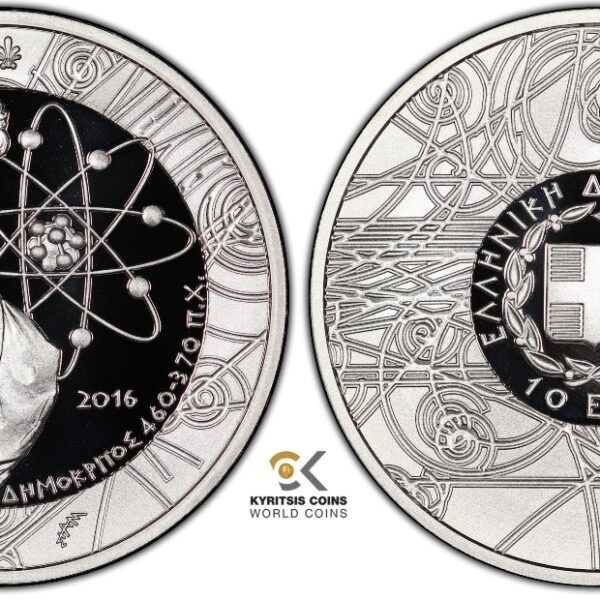
10 euro 2016 Proof Democritus
Greek collectible silver proof coin with a face value of 10 euros, for Democritus (460-370 BC), maximum number of 2,000 pieces, Bank of Greece mint, issued in 2016.
The photo is indicative, the coin you will receive is in the original box along with the certificate of authenticity.
Demokritos is considered the forefather of modern atomic theory. He was born in Abdera, Thrace, and mentored by Lefkippos. His extensive travels in Ionia brought him into contact with the teachings of the great Ionian philosophers (Thales, Anaximander, Anaximenes, Herakleitos). A truly universal spirit, he was erudite in almost all fields of human knowledge, as evidenced by the diversity of his writings on ethics, physics, mathematics, music, cosmology and technology, and visited many places of the then known world. According to his atomic theory, all material bodies consist of invisible, indestructible, unalterable and indivisible particles, which he called atoma (“atoms”), the Greek word for “indivisible”. In reaction to Parmenides’s static philosophy, Demokritos saw the world as being in constant motion and change. He also refuted the concept of teleology, i.e. that there is an underlying purpose to everything. Demokritos was the last of the great pre-Socratic philosophers, who were to have a profound influence on modern philosophy.
| Issuer | Greece  |
|---|---|
| Ruling authority | Third Hellenic Republic (1974-date) |
| Type | Non-circulating coins |
| Year | 2016 |
| Value | 10 Euros (10 EUR) |
| Currency | Euro (2002-date) |
| Composition | Silver (.925) |
| Weight | 34.1 g |
| Diameter | 40 mm |
| Shape | Round |
| Technique | Milled |
| Orientation | Medal alignment ↑↑ |

10 lepta George I 1882-A MS64 BN PCGS
Greek copper coin 10 lepta, King George I, dated 1882-A. Portrait of mature King George I facing left, date below, engraver's initials in Greek under the portrait. Denomination within wreath, mint mark below.
| Issuer | Greece |
|---|---|
| King | George I (1863-1913) |
| Type | Standard circulation coin |
| Years | 1878-1882 |
| Value | 10 Lepta (0.10) |
| Currency | First modern drachma (1832-1944) |
| Composition | Bronze (95% Copper, 4% Tin, 1% Zinc) |
| Weight | 10 g |
| Diameter | 30.3 mm |
| Thickness | 1.8 mm |
| Shape | Round |
| Technique | Milled |
| Orientation | Coin alignment ↑↓ |
| Demonetized | Yes |

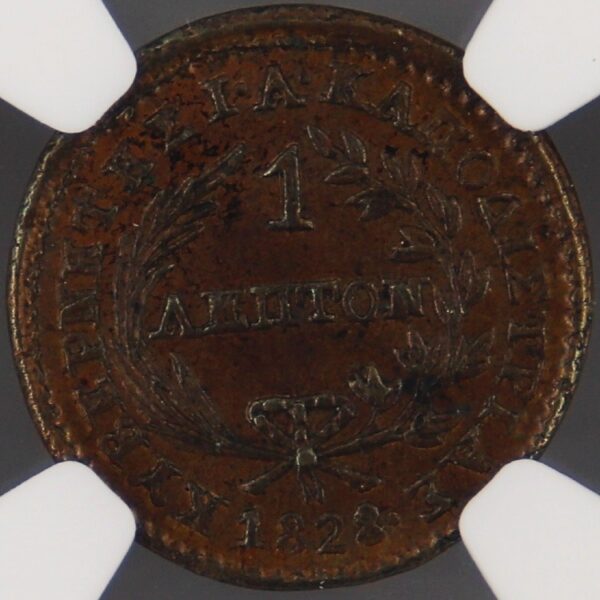
10 lepta Otto 1833 MS65+ BN PCGS
Greek copper coin 10 lepta, King Otto, dated 1833. Shield with cross, crown on top. Denomination and date within wreath.
| Issuer | Greece |
|---|---|
| King | Otto (1832-1862) |
| Type | Standard circulation coin |
| Years | 1833-1844 |
| Value | 10 Lepta (0.10) |
| Currency | First modern drachma (1832-1944) |
| Composition | Copper |
| Weight | 12.990 g |
| Diameter | 28 mm |
| Thickness | 2 mm |
| Shape | Round |
| Technique | Milled |
| Orientation | Medal alignment ↑↑ |
| Demonetized | Yes |


20.000 drachmas Italian Invasion of Greece 1990 PF69 ULTRA CAMEO NGC
Greek commemorative gold proof coin with a face value of 20,000 drachmas, for the 50th anniversary of the NO of 1940, Italian Invasion, maximum number of 1000 pieces, Bank of Greece mint, issued in 1990.
VIDEO
| Issuer | Greece |
|---|---|
| Ruling authority | Third Hellenic Republic (1974-date) |
| Type | Non-circulating coins |
| Year | 1990 |
| Value | 20 000 Drachmes (20 000 GRD) |
| Currency | Third modern drachma (1954-2001) |
| Composition | Gold (.900) |
| Weight | 8 g |
| Diameter | 24 mm |
| Shape | Round |
| Technique | Milled |


200 euro 2014 Proof Aristotelis Aristotle
Greek collectible gold proof coin with a face value of 200 euros, for Aristotle (384-322 BC), maximum number of 600 pieces, Bank of Greece mint, issued in 2014.
A student of Plato’s and tutor to Alexander the Great, Aristotle was one of the great figures of ancient Greek philosophy. Born in Stageira, Chalkidiki, Aristotle spent many years in Athens, where, after leaving Plato’s Academy, he later founded a school of his own, the Lyceum. Distancing himself from the idealism of the Academy, Aristotle believed that true knowledge should be acquired through empirical observation and sense perception. His work laid the foundations for numerous disciplines, such as logic, physics, biology, psychology, ethics, rhetoric and political science. His influence was immense until the Renaissance, spreading across major civilisations, from the Arab to the Western European.
| Issuer | Greece |
|---|---|
| Period | Third Hellenic Republic (1974-date) |
| Type | Non-circulating coins |
| Year | 2014 |
| Value | 200 Euros (200 EUR) |
| Currency | Euro (2002-date) |
| Composition | Gold (.917) |
| Weight | 7.9881 g |
| Diameter | 22 mm |
| Shape | Round |
| Technique | Milled |
| Orientation | Medal alignment ↑↑ |
