We Buy Collectible Coins & Banknotes


-15%


Greek Euro coin set 2017 Proof (8 coins)
Original price was: 180,00 €.140,00 €Current price is: 140,00 €.

6 euro 2016 Proof 50 Years of Television
Original price was: 150,00 €.130,00 €Current price is: 130,00 €.
Greek Euro coin set 2014 Proof (8+2 coins)
Original price was: 200,00 €.170,00 €Current price is: 170,00 €.
Official issue Greek series euro coin set, proof, 8+2 coins, maximum number of pieces 2.500, Bank of Greece mint, issued in 2014. Each coins series is accompanied by a separate certificate of authenticity.
2014 COMMEMORATIVE CIRCULATION COINS
The set contains all eight denominations of the Greek euro coins (1, 2, 5, 10, 20, 50 cents €1 and €2), plus the two €2 coins commemorating “400 years from the death of Domenikos Theotokopoulos” and “150 years from the unification of the Ionian islands with Greece”.
In stock
Additional information
| Material | |
|---|---|
| Condition | |
| Chronology | |
| Country |
Related products

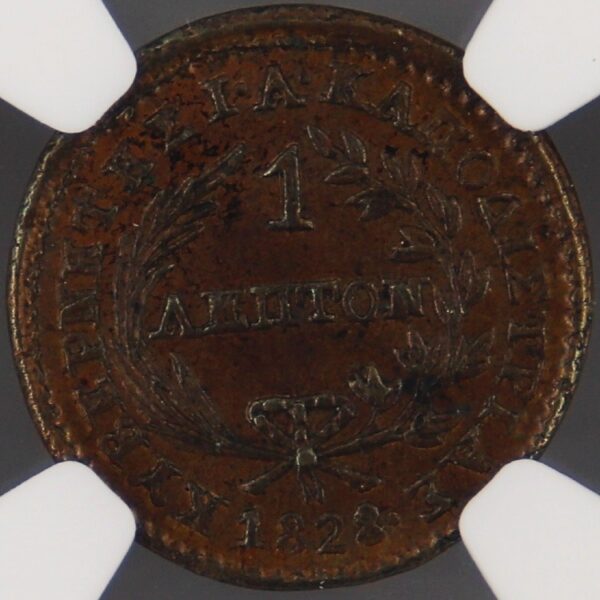


10 euro 2014 Proof Euripides
Greek collectible silver proof coin with a face value of 10 euros, for Euripides (485-406 BC), maximum number of pieces 1,200, mint Bank of Greece, issued in 2014.
The photo is indicative, the coin you will receive is in the original box along with the certificate of authenticity.
Euripides was the youngest of the three great Athenian tragedians of the 5th century B.C. and, as has been said, the most tragic. He reached manhood during the classical age of rhetoric, sophistic and philosophy, living at a time of rapid changes and major achievements in all spheres of culture. Influenced by the new currents, Euripides attempted a novel and bolder treatment of the myths on which the plot of Greek tragedies was almost always built, raising moral questions that are still difficult to answer today. A distinctive characteristic of his art was the realistic portrayal of his heroes and their passions. The fact that Euripides was awarded fewer victories at the dramatic festivals of Athens than his counterparts Sophocles and Aeschylus suggests that his radical approach caused unease among the Athenian public. Towards the end of his life, Euripides retired to the court of Archelaos, king of Macedon, where he wrote his last masterpiece, the tragedy Bacchae.
| Issuer | Greece  |
|---|---|
| Ruling authority | Third Hellenic Republic (1974-date) |
| Type | Non-circulating coins |
| Year | 2014 |
| Value | 10 Euros (10 EUR) |
| Currency | Euro (2002-date) |
| Composition | Silver (.925) |
| Weight | 34.10 g |
| Diameter | 40 mm |
| Shape | Round |
| Technique | Milled |
| Orientation | Medal alignment ↑↑ |

10 lepta Otto 1833 MS65+ BN PCGS
Greek copper coin 10 lepta, King Otto, dated 1833. Shield with cross, crown on top. Denomination and date within wreath.
| Issuer | Greece |
|---|---|
| King | Otto (1832-1862) |
| Type | Standard circulation coin |
| Years | 1833-1844 |
| Value | 10 Lepta (0.10) |
| Currency | First modern drachma (1832-1944) |
| Composition | Copper |
| Weight | 12.990 g |
| Diameter | 28 mm |
| Thickness | 2 mm |
| Shape | Round |
| Technique | Milled |
| Orientation | Medal alignment ↑↑ |
| Demonetized | Yes |
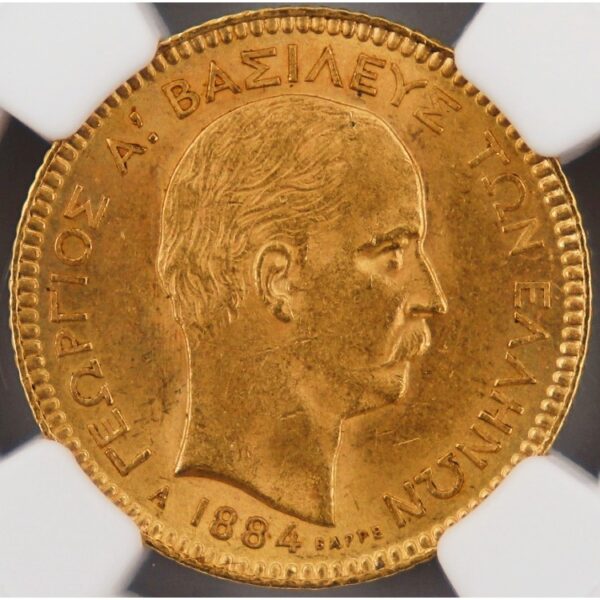


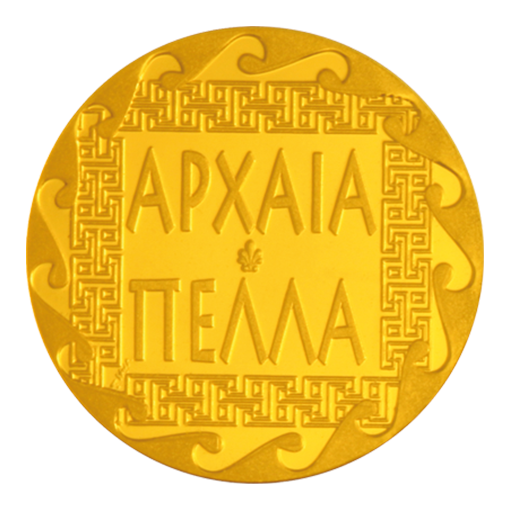

50 euro 2012 Proof Ancient Pella
Greek collectible gold proof coin with a face value of 50 euros, for Ancient Pella where it became the capital of the Macedonian state at the end of the 5th - beginning of the 4th century BC, maximum number of pieces 4,000, mint Bank of Greece, issue in 2012.
The photo is indicative, the coin you will receive is in the original box along with the certificate of authenticity.
Pella supplanted Aigai as the capital of the Macedonian state at the turn of the 5th and 4th centuries BC and soon evolved into a major political, economic and cultural centre in Greece. The birthplace of Alexander the Great, Pella reached its peak during the Hellenistic period. The rich archaeological finds, notably the palace complex, temples and sumptuous private houses, provide a wealth of information about the city’s layout, architecture and economic life. The mosaic floors and the wall-paintings, rare surviving samples of ancient Greek painting, attest to the prosperity of the city and its inhabitants. Pella fell to the Romans in 168/167 BC and began to lose importance once the seat of the Roman province of Macedonia, created in 148 BC, was transferred to Thessaloniki. Pella was destroyed by an earthquake, most probably in the early 1st century BC.
| Issuer | Greece |
|---|---|
| Ruling authority | Third Hellenic Republic (1974-date) |
| Type | Non-circulating coins |
| Year | 2012 |
| Value | 50 Euros (50 EUR) |
| Currency | Euro (2002-date) |
| Composition | Gold (.999) |
| Weight | 1.00 g |
| Diameter | 14.00 mm |
| Shape | Round |
| Technique | Milled |
| Orientation | Medal alignment ↑↑ |


50 euro 2014 Proof Cycladic Culture & Civilization
Greek collectible gold proof coin with a face value of 50 euros, for the Cultural Heritage of Cycladic Culture, maximum number of 1,000 pieces, Bank of Greece mint, issued in 2014.
The Cycladic Civilisation is the earliest important civilisation to emerge during the Bronze Age in Greece, with remarkable achievements dating as far back as 3200 B.C. The Cyclades inhabitants soon organised themselves into thriving settlements that benefited from sea trade and the abundance of valuable raw materials such as obsidian (Milos) and marble (Paros). The austere landscape of the small Cycladic islands gave rise to a civilisation characterised by abstraction and stark simplicity. The numerous archaeological artefacts unearthed on the islands include the world-famous Cycladic figurines, which influenced modern art. The Cycladic Civilisation influenced the Minoan Civilisation in its early phase and contributed to the cultural flourishing of Crete and Mycenaean Greece in the Bronze Age. The prehistoric city of Akrotiri on the island of Santorini, perfectly preserved for having been buried for thousands of years under volcanic ash, provides a window into Cycladic Civilisation in its later phase.
| Issuer | Greece |
|---|---|
| Period | Third Hellenic Republic (1974-date) |
| Type | Non-circulating coins |
| Year | 2014 |
| Value | 50 Euros (50 EUR) |
| Currency | Euro (2002-date) |
| Composition | Gold (.999) |
| Weight | 1.00 g |
| Diameter | 14.00 mm |
| Shape | Round |
| Technique | Milled |
| Orientation | Medal alignment ↑↑ |

500 drachmai Chess 1988 Proof
Greek commemorative silver proof coin with a face value of 500 drachmas, for the 28th Chess Olympiad (Thessaloniki 1988), Bank of Greece Mint, issued in 1988. The photo is indicative, the coin you will receive is in the original box along with the certificate of authenticity.
| Issuer | Greece |
|---|---|
| Period | Third Hellenic Republic (1974-date) |
| Type | Non-circulating coins |
| Year | 1988 |
| Value | 500 Drachmai (500 GRD) |
| Currency | Third modern drachma (1954-2001) |
| Composition | Silver (.900) |
| Weight | 18.11 g |
| Diameter | 34 mm |
| Shape | Round |
| Technique | Milled |